
%20BB.png)
Dolly, Delight, and the Feminine Divine

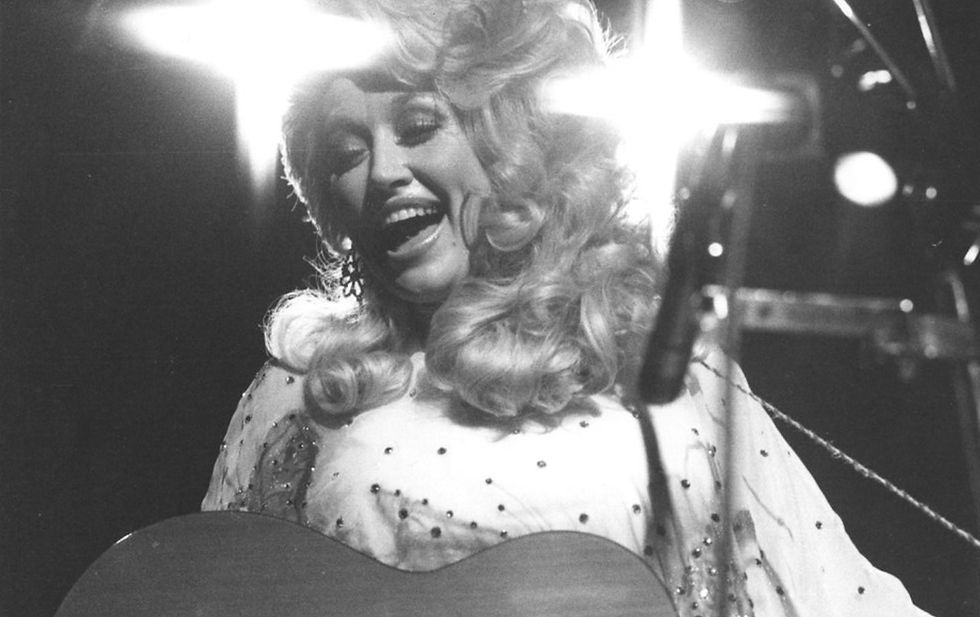
Dolly Parton has completed her life’s heroic journey. To use Joseph Campbell’s terminology, the Separation phase of that journey began when she was born. The Initiation phase began, perhaps, when she moved to Nashville and entered the fray of the music industry, and maybe the Return phase or closing act began with her philanthropic work, when she began returning to others some of the vast resources she had gained. Her Return phase ended with her passing, but her presence lives on so powerfully that I can only call it mythic. By crafting and creating that mythic presence, Dolly embodied the role of a goddess. She embraced both feminine divinity and the humility of her humanity with an unswerving commitment to her own personal goddess values.
Sweetly subversive goddess mythology
Dolly Parton expressed goddess mythology in many ways. She made herself visually mythic, cultivating a shape, clothing, hair, and makeup that lifted her presence out of the ordinary and into the feminine extraordinary. Mythic stories sprang up in the wake of her footsteps, as evidenced by the deluge of anecdotes about her that flooded social media after her death. But most of all, she created mythic goddess music. For example, her seemingly simple song “Coat of Many Colors” intertwines the human and divine as though weaving a magic carpet to ride out of poverty and patriarchy and into the realm of the goddess.
In Genesis 37, the powerful patriarch Jacob gives his son Joseph a special coat—a “coat of many colours” as the King James Bible translates it—to show that Joseph is the favorite of Jacob’s many children. It’s a profound story, but women are almost entirely absent from it. In Dolly’s “Coat of Many Colors,” on the other hand, a mother with few financial resources fashions a coat for her daughter out of cast-off rags and invokes the sacred Biblical story to help imbue the daughter’s coat with a mother’s blessing. The mother creates the coat with her own hands, “sewing every piece with love.” She prophesies that the coat will bring “good luck and happiness,” and then she “blessed it with a kiss.” Through the love and creativity of the feminine divine, this mother turns literal rags into the riches of a mother’s love and a coat even more powerful than Joseph’s.
Genesis 37 and “Coat of Many Colors” both tell stories about large families. Both recount a parent’s love for their child. Both foreshadow success for the child. But one highlights a wealthy father and son, while the other emphasizes an impoverished mother and daughter. The song brings creative goddess energies into conversation with patriarchal hierarchies. These conditions can exist, the song declares. Men often have more power than women, and the wealthy have more than the poor. But love—especially a mother’s love—can eclipse power and wealth. In a radical gesture, the song points to unjust disparities but doesn’t judge them. Instead, the song accepts the situation and uses it as the raw material for creative expression. Dolly’s creativity turned patriarchal patterns inside out, creating wealth for a woman and music that sanctified a mother.
Returning with many boons
What are Dolly’s creative goddess values? Acceptance, delight, love, abundance, generosity, creativity, music. These are some of the sacred gifts she brought back on her life’s journey. More people sing more songs thanks to her. She inspired creativity. In a commencement address at the University of Tennessee, Dolly advises:
If I had but one wish for you it would be for you to dream more … Don’t confuse dreams with wishes. There is a difference. Dreams are when you visualize yourself being successful at what’s important to you to accomplish. Now, dreams build conviction because you work hard to pay the price to make sure they come true. Wishes are hoping that things will happen to you, but there’s no fire in your gut, so you have to dream more and never ever ever blame somebody else if it doesn’t happen.
These words align beautifully with Joseph Campbell’s advice to follow your bliss. Dolly had the courage of her convictions to follow her creative bliss. She dared to brave that adventure, she worked hard to succeed, and she wanted others to do the same.
I’m not saying Dolly was perfect. No goddess is. No god is. Like humans, deities are complex and unique. They simply possess unusually strong presence and power. In one of my favorite passages from The Hero with a Thousand Faces, Joseph Campbell writes that divinity and humanity “can be pictured only as distinct from each other—different as life and death, as day and night. ... Nevertheless—and here is a great key to the understanding of myth and symbol—the two kingdoms are actually one. The realm of the gods is a forgotten dimension of the world we know” (188). Dolly Parton lived that reality, seamlessly blending the mundane and the sacred.
Dolly’s fans called her Saint Dolly, or Our Lady of the Holler. At 9:25 PM on the day after she died—9-2-5, a nod to “9 to 5”— buildings and bridges all over the country lit up in pink as though to shine a collective farewell to a pink spirit who still floated in the sky, the home of many deities. Cities declared September 25—another 9-2-5—a new holiday called Dolly Parton Day—the word “holiday” itself being a compound of “holy” and “day.” In death, perhaps the most mortal experience possible, Dolly’s divinity expanded.
Dolly had the courage of her convictions to follow her creative bliss. She dared to brave that adventure, she worked hard to succeed, and she wanted others to do the same.
After Dolly’s death, her song “I Will Always Love You” inundated my social media feed. Her own Instagram account posted a photo of her, this one black and white instead of many colors, signed with the words “I will always love you.” As she passed into spirit, those simple, human words gained new sanctity, and her voice became more divine. Sung and spoken over and over, they are another of the many boons she brought back from her hero’s journey. She sang them, then we sang them, in choruses, in cars, in the shower, with friends. That one song created a flood of love that wouldn’t have existed otherwise.
Dolly created joy for herself and others. She was a beautiful bard, a silly, serious, singing goddess. She shared her resources to bring hope and help to others: books for children, money for vaccine research, medical care. She lived the mythic stories that would live on after her and surely evolve in the telling, but would just as surely capture the sacred spirit of who she was, how she lived, and how she created.
MythBlast authored by:

Joanna Gardner, PhD, is a writer, mythologist, and magical realist who serves as the managing director of the Joseph Campbell Foundation. She is the author of The Practice of Enchantment: MythBlast Essays, 2020-2024 and the lead author of Goddesses: A Skeleton Key Study Guide. Joanna co-founded and co-led the Fates and Graces, hosting webinars and workshops for mythic readers and writers, and she teaches in Pacifica Graduate Institute’s Mythological Studies program. For Joanna's updates and additional publications, you are most cordially invited to visit her website at joannagardner.com.

This MythBlast was inspired by the Return stage of the hero's journey and The Hero with a Thousand Faces.
Now Streaming on Spotify—Explore the MythBlast Playlist
Latest Podcast

In this episode of The Podcast With A Thousand Faces we speak with Rupert Spira about the meeting place between the Direct Path and the mythic imagination. Rupert Spira is a teacher, author, speaker, and former ceramic artist whose work explores consciousness, non-duality, meditation, and the nature of lasting peace and happiness. His books include The Nature of Consciousness, Being Aware of Being Aware, You Are the Happiness You Seek, and The Shining of Being. Drawing from Advaita Vedanta, Kashmir Shaivism, Sufism, Buddhism, Zen, and mystical Christianity, Rupert’s teaching invites us to look directly into the nature of experience and recognize the awareness that is prior to thought, belief, identity, and the story of the separate self. Before becoming widely known as a teacher of non-duality, Rupert spent decades as a ceramic artist, a background that gives his work a rare sensitivity to form, beauty, silence, and attention. Today, through his books, retreats, conversations, meditations, YouTube channel, Substack, and the Luminous meditation app, he continues to guide people toward what he often calls our true nature: the simple awareness of being. Together, Tyler and Rupert explore Joseph Campbell’s understanding of myth as a symbolic journey beyond the limited ego and into a deeper ground of being. They discuss the relationship between myth and direct recognition, the difference between progressive paths and the pathless path, the separate self as a story, poetry, pottery, beauty, the hero’s journey, spiritual integration, and love as the felt recognition of our shared being. This is a conversation about the stories that help us, the stories that limit us, and the possibility of recognizing what is prior to all stories: the quiet, radiant awareness in which life appears.
This Week's Highlights

"The two worlds, the divine and the human, can be pictured only as distinct from each other — different as life and death, as day and night. . . . Nevertheless — and here is a great key to the understanding of myth and symbol — the two kingdoms are actually one. The realm of the gods is a forgotten dimension of the world we know. And the exploration of that dimension, either willingly or unwillingly, is the whole sense of the deed of the hero."
-- Joseph Campbell


