%20BB.png)
“Pink Pony Club” Goes Zero-G


Over the first ten days of April 2026, millions of earthlings witnessed a real-world heroic journey in real time when NASA’s Artemis II mission sent astronauts hurtling into space to orbit the moon then return to Earth. Four astronaut-heroes left homes, families, and breathable atmosphere to brave the vastness of space, change forever, and return with new insights to share with the global community.
Joseph Campbell often discussed his fascination with the 1960’s Apollo moon missions, for example in The Hero’s Journey (91-93), so I can’t help but wonder what he might make of the Artemis program. Almost sixty years have passed since Apollo 11 landed on the moon, and—mythologically speaking—the Apollo and Artemis programs present a striking contrast.
Embracing the spirit of Artemis
First, naming a moon program after Artemis makes far more mythic sense than after Apollo. While both Artemis and Apollo drive chariots of light across the sky—like today’s spacecraft—Artemis is the Greek goddess of the moon, Apollo the god of the sun. Artemis represents nature uncultivated by humans, whereasApollo embodies reason, logic, and intellect. In that sense, naming the mission Artemis better aligns with the wildness of space than with human minds. Focusing on Artemis decenters Apollo who, in our heliocentric solar system, so often takes center stage. In this case, however, he and Artemis joined forces—moon and sun, sister and brother—beautifully united in the majestic eclipse the astronauts witnessed.
Naming the mission after a goddess rather than a god coincides with deeper differences as well. Deity names invoke a sense of the sacred in general, but Artemis’s sacredness carries different connotations than Apollo’s. As the embodiment of nature’s energies, Artemis also symbolizes its attributes, such as diversity and vitality. The crew of the Artemis II mission also embodied those traits. While only white, business-like, American men crewed the Apollo 11 trip to the moon, Artemis II carried one white American man, one white Canadian man, one Black American man, and one white American woman, all radiating joy, humor, and affection. Nowhere was this clearer than in the astronauts’s wake-up playlist of songs.. Hearing Chapell Roan’s compulsively danceable “Pink Pony Club” playing in space, I knew the goddess’s ebullient diversity had taken up residence aboard the Integrity spacecraft.
“Pink Pony Club” tells the story of a heroic journey strikingly similar to that of the Artemis II astronauts. In both cases, protagonists hear a call to venture far from home, be it Earth or Tennessee. “Pink Pony Club” defies the gravitational pull of societal norms and family, while Artemis II defied historical norms as well as literal gravity to take flight and then enter a space of levity, their bodies and spirits floating within the spacecraft. Most of all, the song and the spaceflight both tell of a profound, life-giving transformation that accompanies an embrace of diversity, much like the shift from a focus on Apollo to the wildness of Artemis: new perspectives, new joy, and new insight. Spiritually and psychologically, the Integrity became a Pink Pony Club in space—a place where diversity, vitality, and science could all dance together.
Initiation means deep change
Integrity was, in fact, one of many values embraced by these mythic voyagers. The astronauts also modeled courage, humility, hope, and daring. Their courage enabled them to risk everything for this adventure, their humility connected them with humanity at large, their hope guided them through the decades of work required to become astronauts, and their daring inspires countless others to dream big. These heroic traits demonstrate how mythic stories can proclaim and propagate particular values.
In The Hero with a Thousand Faces, Joseph Campbell describes the Initiation stage of heroic adventures, which often includes a metaphorical road of trials and some kind of meeting with a goddess (81-100). The Artemis II astronauts had two mythic goddess encounters: they visited the moon whose presence filled them with “moon joy,” and they saw with new eyes our own Earth, who revealed to them her own brightness—“Earthshine.” These experiences clearly changed the astronauts, as all initiations do. But their initiation was my initiation, too. I rode along on their road of trials. I listened to their music and felt vicariously renewed through their openness, fun, and awe. Albeit on a far smaller scale, I transformed alongside them. I now experience Earth and the moon more fully, not as inert objects but as sacred beings. Artemis II’s real-life story unfolded for me as a living heroic journey.
Integrity became a Pink Pony Club in space—a place where diversity, vitality, and science could all dance together.
Stories for all humanity
The Artemis II astronauts ensouled space with music, camaraderie, laughter, and skill. They ensouled science. Their diverse, collaborative heroic journey connected people all over the world. Joseph Campbell believed that any new mythology had to be a story of “the whole human race,” not of individual groups and interests (Inner Reaches of Outer Space, xxi). To me, the Artemis II mission makes that observation feel both prophetic and truly possible, not least because of the sixty-three nations so far who have signed the Artemis Accords for cooperating peacefully and safely in space exploration—all under the auspices of the great goddess of the natural world.
When Joseph Campbell wrote The Hero with a Thousand Faces in the 1940s, he cited a quote from Carl Jung in a footnote on page 87: “Heaven has become for us the cosmic space of the physicists, and the divine empyrean a fair memory of things that once were. But ‘the heart glows,’ and a secret unrest gnaws at the roots of our being.” (“Archetypes of the Collective Unconscious,” par. 50). Surely Artemis II’s journey has revised that sentiment. Space once more presents a divine empyrean full of marvels, hearts glow again with mythic wonder and possibility, and bright new hopes now blossom from the shared roots of all humanity.
MythBlast authored by:

Joanna Gardner, PhD, is a writer, mythologist, and magical realist who serves as the managing director of the Joseph Campbell Foundation. She is the author of The Practice of Enchantment: MythBlast Essays, 2020-2024 and the lead author of Goddesses: A Skeleton Key Study Guide. Joanna co-founded and co-led the Fates and Graces, hosting webinars and workshops for mythic readers and writers, and she teaches in Pacifica Graduate Institute’s Mythological Studies program. For Joanna's updates and additional publications, you are most cordially invited to visit her website at joannagardner.com.
This MythBlast was inspired by the Initiation stage of the hero's journey and The Hero's Journey: Joseph Campbell on his Life and Work.
Now Streaming on Spotify—Explore the MythBlast Playlist
Latest Podcast
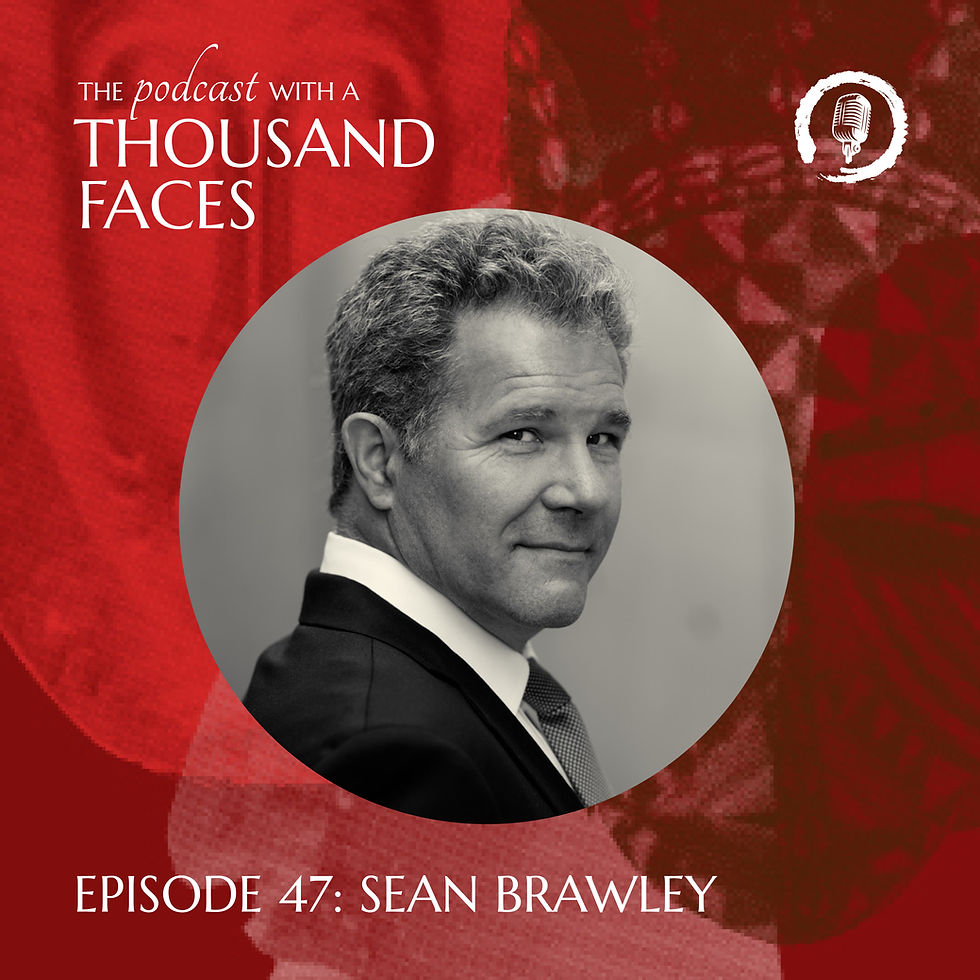
In this episode, Sean Brawley, performance coach, former top-ranked professional tennis player, and expert in accelerated learning, joins John Bucher for a wide-ranging conversation that begins in the world of elite sport and opens into something much deeper. Drawing on his experience competing at the highest levels and his work with Tim Gallwey and the Inner Game philosophy, Sean shares how his understanding of performance shifted from effort and control toward awareness, attention, and the way we learn. From there, the conversation moves into language, etymology, and the hidden layers of meaning within the words we use every day. Along the way, the ideas of Joseph Campbell weave through the discussion, especially the notion of following your bliss and the unexpected turns that shape a life. What emerges is a thoughtful exploration of performance, identity, and how paying closer attention - to both our experience and our language - can open up new ways of seeing and engaging with the world.
This Week's Highlights

"The ends of things are always painful. But pain is part of there being a world at all … "I will participate in the game. It is a wonderful, wonderful opera – except that it hurts."
-- Joseph Campbell
Joseph Campbell and the Power of Myth