
%20BB.png)
Birdsong, Thresholds, and the Infinite: Initiation Ascending with the Lark

Opening the year
Every year on my birthday, I listen to Ralph Vaughan Williams’ The Lark Ascending.
I have for most of my life.
My birthday falls just after the spring equinox, and for as long as I can remember, The Lark Ascending has marked the beginning of the year for me far more than January ever has. January feels administrative. March feels initiatory: the air still carries winter inside it, but the world begins to open again.
I remember sitting on my front step as a child while the music poured out through the open door into that particular kind of early spring light that feels both sharp and welcoming at once. Cardinals sang from the early-blooming serviceberry trees in our yard. The cardinal song and the violin became permanently entwined for me in that moment. Even now, hearing a cardinal unexpectedly can unlock the same feeling in an instant: the world suddenly larger, charged, alive in some difficult-to-name way.
Glastonbury Tor
My parents raised us among books and art and ideas and music, and Britain occupied a particularly mythic place in my imagination. We traveled there when I was twelve, and among the experiences that lodged themselves permanently in my inner world was a visit to Glastonbury Tor. Somewhere, there is a photograph of me sitting among the wildflowers in the grass with buck teeth and singularly unflattering glasses and a long flowing scarf, yearning with my whole heart to be discovered as Guinevere. I love that kid fiercely. She understood something essential about myth and longing and belonging. Story altered reality for her. Places held atmospheres and presences. Music opened doors to the unseen.
Around that time, I began listening to The Lark Ascending every year on my birthday, with a child’s absolute certainty that this mattered. I simply knew I needed to do it. The music marked the opening of the year more profoundly than midnight in January ever could, carrying the feeling of crossing a threshold into possibility, into longing, into the painful and exhilarating vastness of being alive.
The music rises
The music itself invites this so exquisitely.
The opening violin rises almost impossibly lightly, as though it has discovered an updraft beyond ordinary gravity. It circles and climbs and disappears upward, while the orchestra anchors the earth beneath it. Listening to it, something in me rises too, stretching toward something immense and beautiful—something I could feel far more clearly than I could explain. I have cried every year as I listen, without fail.
Over the years, I have brought this ritual to many places. On a ridge in Ojai among spring flowers and chaparral, looking out toward the distant sea. At Esalen, exploring the play in myth in celebration of Joseph Campbell (on the birthday we share, which I choose to believe carries a virtuous symbolism). In the Catskills. In Kentucky. The landscapes change, but the opening remains the same.
Vaughan Williams composed the piece in the years just before the First World War shattered Europe. That threshold hums quietly inside the music for me now, though I could not have understood it as a child. The pastoral beauty of the piece carries an ache within it. One hears a world poised at the edge of immense transformation, beauty and possibility suspended alongside impermanence and loss. Vaughan Williams drew inspiration from George Meredith’s poem, in which the skylark rises “Till lost on his aerial rings / In light, and then the fancy sings.” The bird disappears into radiance while the song continues somewhere beyond sight.
Threshold states
That movement toward infinity has always felt initiatory—liminal, as Victor Turner used the term to describe threshold states where ordinary structures loosen and transformation becomes possible. Initiatory experiences often carry a strange emotional doubleness. The world feels suddenly more vivid, more beautiful, more alive, and yet almost unbearably vast. Becoming more permeable to the world also makes it more overwhelming.
Rilke comes close to this feeling in the Duino Elegies when he writes, “For beauty is nothing but the beginning of terror which we are still just able to bear.” And Rudolf Otto’s description of the sacred as the mysterium tremendum et fascinans—the overwhelming and fascinating encounter with immensity—feels deeply present here as well.
Terror, in this older and sacred sense, stands arm in arm with awe.
This is the feeling this music opens in me every year. The painful beauty of existence itself. The infinite pressing briefly against the edges of ordinary life. The realization that love, grief, memory, mortality, spring light, birdsong, and music all somehow belong to the same vast conversation. The boundaries between grief and joy, longing and belonging, self and world grow more permeable.
Initiatory experiences often carry a strange emotional doubleness. The world feels suddenly more vivid, more beautiful, more alive, and yet almost unbearably vast.
The rose
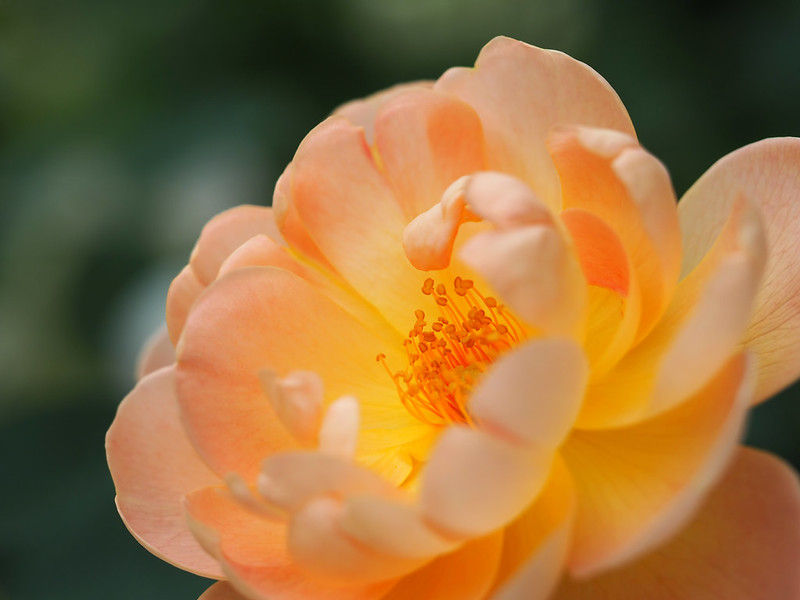
A few years ago, my mother bought a David Austin rose called The Lark Ascending. I went to my parents’ house to plant it for them, and as I dug the hole in the garden, my father appeared carrying a portable CD player and three glasses of champagne. He set the music beside us while we planted the rose together in the afternoon light.
It was the last conversation I would ever have with him before his death.
Later, when my mother moved to Cape Cod, we dug up the rose so it could go with her. Mostly because I needed it to.
That is part of what rituals do, especially the ones we create instinctively long before we have language for them. They gather meaning over a lifetime. They become spaces where memory and love and grief continue speaking to one another. They remind us that initiation is not always about suffering or endurance or proving oneself worthy. Sometimes, it is about remaining permeable to wonder—remaining willing to encounter beauty that opens the heart so fully it aches.
Especially now
Now, each year when I listen to The Lark Ascending, all the other years arrive as well. The stoop. The cardinals. The ridiculous scarf on Glastonbury Tor. Ojai. Champagne in the garden. My father holding the CD player as I dug.
Beneath it all, the same invitation.
Remain open.
Allow yourself to be initiated again into wonder.
Even now.
Especially now.
MythBlast authored by:

Leigh Melander, PhD has an eclectic background in the arts and organizational development, working with inviduals and organizations in the US and internationally for over 20 years. She has a doctorate in cultural mythology and psychology and wrote her dissertation on frivolity as an entry into the world of imagination. Her writings on mythology and imagination can be seen in a variety of publications, and she has appeared on the History Channel, as a mythology expert. She also hosts a radio who on an NPR community affiliate: Myth America, an exploration into how myth shapes our sense of identity. Leigh and her husband opened Spillian, an historic lodge and retreat center celebrating imagination in the Catskills, and works with clients on creative projects. She is honored to have previously served as the Vice President of the Joseph Campbell Foundation Board of Directors.
This MythBlast was inspired by the Initiation stage of the hero's journey and The Hero's Journey: Joseph Campbell on his Life and Work.
Now Streaming on Spotify—Explore the MythBlast Playlist
Latest Podcast

The Podcast With A Thousand Faces is an official podcast of the Joseph Campbell Foundation and the MythMaker Podcast Network featuring interviews and conversations focused on the influence of Joseph Campbell, his work, and myth in culture.Check out our latest episode with Sean Brawley, and then dive into our archive to see all of the ways that Campbell's work continues to influence the world today. Subscribe and listen wherever you get your podcasts. Share with your friends and leave us a review!
This Week's Highlights

"It is necessary for men to understand, and be able to see, that through various symbols the same redemption is revealed. “Truth is one,” we read in the Vedas; “the sages call it by many names.” A single song is being inflected through all the colorations of the human choir."
-- Joseph Campbell


