
%20BB.png)
Between The Matrix and The Chosen: A Journey into the Prophet Archetype


An unexpected challenge
When the kind invitation arrived from the Joseph Campbell Foundation to write a second MythBlast for the year—this time on the archetype of the Prophet—my heart immediately answered: “Yes.” How hard could it be? I thought. Naively, I assumed the archetype would simply reveal itself. Of course, the wise folks at the Foundation knew better. I would learn quickly.
Almost immediately, two powerful narratives surfaced from my unconscious, each carrying its own prophetic figure. The first was The Matrix (1999), a landmark of science fiction, philosophy, and action that had somehow eluded me for twenty-five years. The second was The Chosen (2017-present), a series that portrays the life of Jesus with unusual freshness and emotional intimacy.
One figure resists his prophetic destiny; the other seems born into it. Between Neo and Jesus, the Prophet archetype unfolded in contrasting, yet complementary, ways.
The reluctant prophet: Neo’s red pill
In The Matrix, Neo’s (Keanu Reeves) journey begins not with divine annunciation but with existential doubt. A hacker haunted by the sense that reality is not what it seems, he is offered a fateful choice by Morpheus (Laurence Fishburne): the blue pill, to remain in comforting illusion, or the red pill, to awaken to the truth. He chooses the latter—and is thrust into a dystopian world where humanity is enslaved by machines.
Morpheus hails him as “The One,” the prophesied liberator destined to manipulate the Matrix and free humanity. Yet Neo’s first response is denial. Like many mythic heroes, he refuses the call. Prophetic identity is rarely accepted lightly; it entails the weight of collective expectation, an often crushing responsibility.
As the trilogy unfolds, Neo must die to his old self to embrace his role fully. He becomes a prophet not because he seeks to be, but because reality—and the community around him—demand it. His path echoes Campbell’s monomyth: the refusal of the call, descent into the unknown, and eventual return, transformed. Neo’s prophetic power emerges through hard-won self-knowledge and sacrifice, not predestination. After all, is he really The One?
The predestined prophet: Jesus in The Chosen
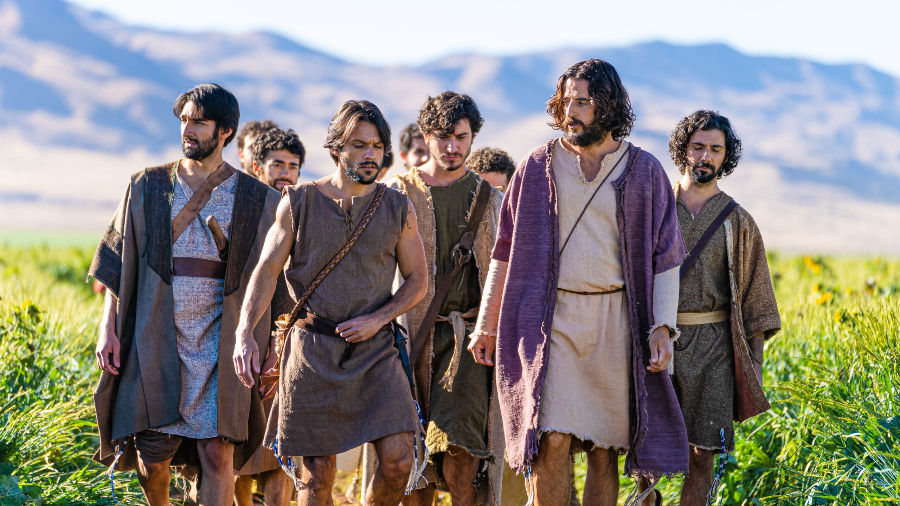
In contrast, Jesus’ story as portrayed in The Chosen begins with a divine message. In the Gospel of Luke, the angel Gabriel announces to Mary that she will bear a son destined to be called “the Son of the Most High.” Unlike Neo, Jesus’ identity as a prophet is proclaimed before his birth.
This series captivated me in a way that The Matrix never had. Perhaps because, as an Italian-Brazilian raised in a Christian cultural landscape, this story is etched into my spiritual passport. The Chosen brings a sense of intimacy and immediacy to a narrative known by billions. It depicts Jesus not as a distant figure of doctrine but as a living, breathing presence—both deeply human and unmistakably numinous.
Jonathan Roumie’s portrayal of Jesus carries the quiet authority of one who knows his path and accepts it fully —except, of course, at the profoundly human moment of the crucifixion, when he cries out, “Father, why have you abandoned me?”. His prophetic destiny is not the result of resistance overcome but of a mission embraced. This portrayal captures the essence of the prophet as vessel—one who allows a larger message to flow through, often at great personal cost.
Prophets and the Self
In Psychological Types (636), Carl Jung writes that prophets, like heroes and saviors, express the Self—the archetype of wholeness that encompasses both the known and the unknown dimensions of the psyche. Prophetic figures are therefore not just religious leaders or seers; they are symbolic manifestations of the human capacity to perceive, embody, and transmit larger truths.
The prophet stands at a threshold between the visible and invisible worlds. Sometimes this role is embraced willingly; sometimes it is thrust upon the individual. Neo embodies the reluctant prophet who must grow into his role through trials and transformations. Jesus embodies the predestined prophet who enters the world already carrying the message of who he is. Both reveal, in different ways, the psychological tension between individual development and collective expectation.
Joseph Campbell often emphasized that mythological archetypes are not distant relics but living patterns within us. Each of us may, at times, be called to a prophetic stance—to speak uncomfortable truths, to see further than those around us, or to bear a vision that others cannot yet grasp, often at great personal cost.
The shadow of the Prophet
Prophetic vision is not without danger. When the search for truth becomes rigid or disconnected from reality, the prophet archetype can darken. Jung warns that archetypes carry both creative and destructive potentials; the prophet’s certainty can inspire transformation—or delusion.
Neo ultimately dissolves the prophecy that burdens him, choosing a self-sacrifice that frees both humanity and himself from the weight of expectation. Jesus, in contrast, walks knowingly toward his crucifixion, carrying the prophetic path to its ultimate extreme. In a sense, they embody what some Jungian analysts, such as psychiatrist David Rosen, term egocide—a symbolic sacrifice of the ego, relinquishing what is obsolete in service of a higher principle. These two narratives, therefore, illuminate the paradoxical nature of the prophetic calling: it can liberate or bind, inspire or isolate, depending on how the vision is borne.
Living the archetype
Prophetic figures remind us that transformation often begins with vision—sometimes reluctant, sometimes embraced. Whether we identify more with Neo’s hesitant steps or with Jesus’ steadfast mission, the archetype invites us to listen to the deeper currents of the psyche and the world.
Campbell once wrote, “The very cave you are afraid to enter turns out to be the source of what you are looking for” (A Joseph Campbell Companion: Reflections on the Art of Living, 24). For prophets, that cave is often the unknown future—the space where their vision collides with collective destiny. To enter it is to risk everything; to avoid it is to deny the call.
Prophetic figures remind us that transformation often begins with vision—sometimes reluctant, sometimes embraced.
In our turbulent times, the Prophet archetype whispers still, calling individuals and communities to see differently, speak courageously, and act with integrity. Whether we accept or resist, the call itself is part of the journey.
MythBlast authored by:

Monica Martinez is a Brazilian writer, researcher, and professor whose work bridges communication, narrative, and Jungian psychology. She holds a Ph.D. from the University of São Paulo (ECA-USP) and postdoctoral degrees from UMESP and Universidade Fernando Pessoa (Portugal), exploring how stories shape identity, transformation, and social change. A clinical psychologist and Jungian analyst trained by IJEP, she maintains a private practice in São Paulo. Martinez teaches at the University of Sorocaba (Uniso) and coordinates the JORLIT research group on Literary Journalism and Transformative Narratives. She has authored several books and articles on literary journalism and psychological storytelling. Mother of Laura, 28, she believes in the enduring magic of narratives to heal, guide, and renew the human spirit.

This MythBlast was inspired by Myth & Meaning and the archetype of The Prophet.
Latest Podcast

C.J. Macias is a big wave surfer, healer, and teacher whose life feels as mythic as it is deeply human. Featured in HBO’s Emmy Award–winning series 100 Foot Wave, C.J.’s journey stretches from the beaches of Florida, where he first surfed with his dad, to Nazaré, Portugal, home of the largest waves on earth. Along the way he has faced devastating wipeouts, near-death moments, and the kind of initiations that strip life down to its essence. In 100 Foot Wave, we witness not only the danger and beauty of Nazaré, but also the brotherhood among surfers, the intimate dance with fear, and the transformation that comes from surrendering to the ocean’s immense power. In this conversation, we explore C.J.’s path, his call to big waves with Garrett McNamara, his evolving relationship with fear and the unknown, the ocean as teacher, and how Joseph Campbell’s vision of myth resonates with his own path.
This Week's Highlights

"The very cave you are afraid to enter turns out to be the source of what you are looking for”
-- Joseph Campbell


