
%20BB.png)
Finding Our Way Back: An Odyssey Toward Heart and Home


The sweetest thing in all my life has been the longing …
Do you think it all meant nothing, all the longing? The longing for home?
For indeed it now feels not like going, but like going back.
—C.S. Lewis, Till We Have Faces
I first heard Jefferson Starship’s “Find Your Way Back” (from 1981’s Modern Times) in high school, before I had left the nest for a greater adventure. I loved the music itself, right from the opening picked, descending guitar line, which immediately signaled the song’s melancholic tone. Many years would pass, however, before the lyrics spoke to me and I could echo the opening words: “It’s been a long, long road / Since I packed up and left on my own.” Only later in life did the song hit me with its mythic truth: the journey away is always the first step toward the journey back. This is the essence of Initiation, the phase of the hero’s journey where the seeker, having braved the adventure, now dares to face trials, to confront their shadow, and to begin the arduous work of returning home. “Find Your Way Back” is more than a simple love song; it’s a modern initiation anthem, a musical map of the soul’s path from exile to reunion.
Joseph Campbell often spoke of the hero’s journey as a metaphor for the human experience of growth. The Initiation phase in particular is where the hero, having left the ordinary world, endures trials and begins the process of reintegration. In “Find Your Way Back,” the narrator is deep in this phase. They are not just physically distant from “her heart”; they are emotionally and spiritually adrift, carrying a “heavy load” of regret, longing, and the weight of their choices.
The song mirrors the hero’s journey, in both its lyrics and music. The verses, with full-band energy, describe the descent (“I seem to find love where I ramble”). But then, as if to underscore the arresting quality of the summons, the band drops out in each of the first two choruses, leaving only a muted guitar and high keyboards to carry the call to return: “Find your way back to her heart.” The bridge then offers a dramatic key change and a revved-up and rockier sound. When the lyrics then reveal the reckoning (“I wish I could go back in time … And get it right from the start”), the band shifts into double-time—a sonic rebirth and a lift toward the return.
Odysseus’ rambling way back
If “Find Your Way Back” is a song of Initiation, then The Odyssey is one of its mythic predecessors. Odysseus, too, is a hero in the throes of this phase for much of the epic. His trials, from the Cyclops to Circe to Calypso, aren’t just obstacles; they’re rites of passage, forcing him to shed his old identity as a warrior and emerge as a man capable of ruling Ithaca in partnership with his wife, Penelope, with wisdom and humility.
The song and The Odyssey exhibit striking parallels. The narrator’s “long, long road” echoes Odysseus’ ten-year voyage, as much about inner transformation as about covering distance. The line “I carry a heavy load” could be Odysseus’ lament after losing his crew or enduring Poseidon’s wrath, let alone the traumas of the Trojan War. And the repeated chorus of “Find your way back to her heart” mirrors Odysseus’ singular focus on returning to Penelope, the ultimate symbol of home and restoration.
But the most compelling connection is the theme of return as rebirth. In The Odyssey, Odysseus doesn’t just go home; he becomes someone new. He sheds his old self—the brash, prideful warrior who left Ithaca—and returns as a man who has faced his own mortality, his own flaws, and the consequences of his actions. Similarly, the narrator of the song isn’t just trying to reunite with a lover; they are trying to reclaim an interior part that they lost along the way, a part they have only realized in the humility of their humanity. The song’s final verse, the narrator’s futile wish to “start all over somehow,” embodies a moment of mythic reckoning, akin to Odysseus weeping on Calypso’s shore and realizing the cost of his detours.
The Hymn of the Pearl: the voice of the eagle
Another surprising and ancient parallel to “Find Your Way Back” lies in the Hymn of the Pearl—a Gnostic poem from the Acts of Thomas. In the hymn, a prince is sent from his heavenly home to retrieve a pearl but falls into a deep sleep in Egypt, forgetting his mission and his royal origins. Only when a letter in the form of an eagle from his father, the king, reaches him does he awaken, remember his purpose, and begin the journey back.
The echoes of the lyrics here are also uncanny. The prince’s forgetfulness mirrors the narrator’s rambling in the song, as if he, too, has lost sight of his true path and the courage of his convictions. The eagle from the king is the song’s “voice” that in essence says, “Find your way back.” And the pearl? It’s the same as the song’s “heart” or Odysseus’ Ithaca/Penelope: the ultimate boon, the thing the hero must reclaim to complete the journey.
The Hymn of the Pearl, The Odyssey, and “Find Your Way Back” all revolve around the same mythic truth: the journey home is often a journey of remembering. The prince forgets his mission; Odysseus loses his way; the song’s narrator disregards their path. But in each case, the call to return—whether it’s a letter, a divine intervention, or a mysterious voice—awakens them to their true purpose.
The mythic pull of home
Campbell would argue that this is the power of myth in music and story: they evoke the universal patterns that define our lives. “Find Your Way Back” does exactly that. It’s a modern myth, a song that taps into the same archetypal energy as the Hymn of the Pearl and The Odyssey. It speaks to the part of us that has wandering feet but a homesick heart. And the echoed and harmonized repetition of the word “Back, back, back, back…” at the song’s end reminds us of the hope we hear in harmonizing our intention with what lies at the end of the adventure.
The way home isn’t just about distance; it’s about remembering who we are.
The way home isn’t just about distance; it’s about remembering who we are. Whether it’s a prince’s pearl, a king’s partnership with his queen, or a lover’s heart, the mythic call is the same: find your way back. And perhaps most importantly, this song invites us to see our own lives as mythic. When we hear Jefferson Starship’s tune, we’re not just listening to a song about re-finding love; we’re hearing a call to our own initiation. We’re being invited to ask: what is the “heart” in your life you are being summoned back to? What is the “pearl” you’ve been sent to retrieve? What is the Ithaca you’re trying to reach?
MythBlast authored by:

Scott Neumeister is a literary scholar, author, TEDx speaker, and mythic pathfinder from Tampa, Florida, where he earned his PhD in English from the University of South Florida in 2018. His specialization in multiethnic American literature and mythology comes after careers as an information technology systems engineer and a teacher of English and mythology at the middle school and college levels. Scott coauthored Let Love Lead: On a Course to Freedom with Gary L. Lemons and Susie Hoeller, and he has served as a facilitator for the Joseph Campbell Foundation’s Myth and Meaning book club at Literati.
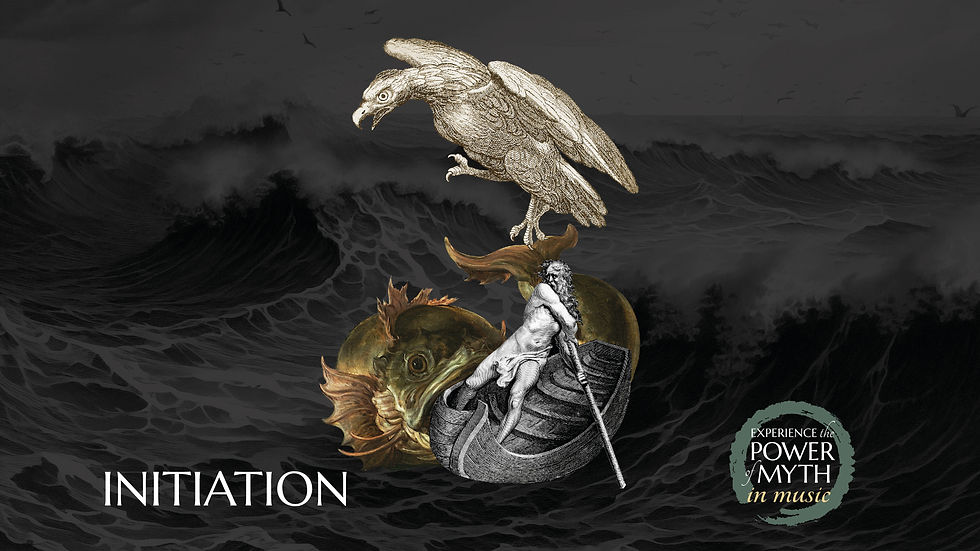
This MythBlast was inspired by the Initiation stage of the hero's journey and The Hero's Journey: Joseph Campbell on his Life and Work.
Now Streaming on Spotify—Explore the MythBlast Playlist
Latest Podcast

In this special bonus episode of The Podcast With A Thousand Faces, author, mythologist, and longtime friend of the Joseph Campbell Foundation Phil Cousineau returns to discuss his new book, The Wisdom of The Odyssey. In conversation with JCF’s John Bucher, Phil explores why Homer’s ancient epic continues to speak so powerfully to the modern world, especially as Christopher Nolan’s new film adaptation brings The Odyssey back into popular culture. Together, they reflect on Odysseus’ long journey home not simply as an adventure story, but as a map of the soul - a timeless meditation on memory, exile, temptation, self-control, wisdom, and the deep human longing to return to what is most true. This conversation invites us to ask what our own odysseys are teaching us, what we may have forgotten along the way, and what wisdom we are being called to bring home.
This Week's Highlights

"And then you have the shamanic experience of the Northern peoples, the Siberians, and down in South America. And what it’s associated with in the North and the Americas is the song. Every shaman has his song that takes him away. There have been descriptions of how a person first hears his or her song, walking along a seashore or being in in a forest. There’s this experience and from then on he’s overtaken."
-- Joseph Campbell


