%20BB.png)
The Monomyth of Wolfgang Amadeus Mozart


How rarely can we tap into the well of inspiration and transcend universal ideas and emotions? How special it is to exit Plato's Cave of shadows and return with illumination. Two brilliant minds stand at the mouth of Plato’s Cave, blinking from an excess of ideas: Joseph Campbell, the cartographer of myth, and Wolfgang Amadeus Mozart, its composer. One maps the journey; the other lends voice to it. Campbell gives us the grammar of transformation in the Hero’s Journey. Mozart turns this grammar into vibration of frequencies; into something the body understands before the mind catches up. One speaks in words, the other in sound, but both describe the same journey: departure from certainty, confrontation with chaos, discovery of meaning, and transcendence. If Plato feared poets for their ability to seduce the soul, he would have banished Mozart. His works journey through Campbell’s map of heroes. Campbell charted it, Mozart threaded it. If we listen closely we might notice something unsettling: the journey is not just his. It is ours, seducing us softly from the background, waiting for us to recognize the D minor. The hope we hear in the harmony of Mozart's music is where chaos finds order, where sound reassures us that we all belong together.
Biographical monomyth
Every hero begins somewhere ordinary. For Mozart, it's the Salzburg period: respectable, suffocating, hierarchical. He was born into music—and into discipline. Leopold Mozart was not merely a father; he was a gatekeeper. Young Wolfgang lived in a world where talent was currency, and obedience the price of survival. No dragons, just wigs, etiquette, and bishops. Campbell insists that the hero’s world is often too ordered. The rule-breaker’s early childhood was practically embalmed in hierarchy and authority.
The Call to Adventure comes early. He was composing at five. That’s not talent; that’s a summons. The prodigy tours were the Road of Trials. But the Call wasn’t his own. It was mediated by the Father. Refusal of the Call is delayed and internal. Children don’t rebel; they comply. The refusal comes later, and it’s psychological: resentment, sarcasm, emotional volatility. Campbell notes that refusal often appears as immaturity or misalignment with authority. Mozart’s famous irreverence wasn’t a personality quirk but a symptom of a rock star’s genius and craziness. Leopold is the Mentor who gives training and access. But unlike Gandalf, he doesn’t step aside. Campbell warns that when the mentor doesn’t let go, the hero struggles to individuate. Mozart’s tragedy begins here.
Crossing the First Threshold is Mozart’s break with Archbishop Colloredo of Salzburg. The hero rejects the tyrant-king and steps into the uncertainty of Vienna. Freedom replaces security. This is the leap into the unknown where tests, allies, and enemies await in the Vienna labyrinth. There is no Minotaur, just landlords, fickle audiences, rival composers, alcohol and fashion. Mozart excels artistically but fails materially. He is brilliant in music and naive in life. Allies are inconsistent. Enemies are invisible. Patronage is a rigged game. Mozart’s flaw is not arrogance but believing that merit should match talent. A rookie mistake in any hierarchical system. Mozart was not poor because he was ignored. In today’s standard he was a rock star celebrity with millions of followers. He lived in a world transitioning from aristocratic patronage to public markets. Add to this a fondness for good clothes, extravagant partying and drinking; a catastrophic lack of long-term planning; and having no switch-off, you get an artist who earned well but spent faster.
Indifferent to life practicalities, the genius approaches the Inmost Cave of marriage, in love with Constanze. In the cave, identity is tested. Campbell says the hero must confront what he fears most. For Mozart, it wasn’t death. It was irrelevance. His creative peak coincides with material collapse. In The Ordeal phase of the Hero’s Journey, he creates his greatest works: The Marriage of Figaro, Don Giovanni, The Magic Flute, Requiem.
This journey diverges here from Hollywood myth because the system did not recognize the Boon in real time. This comes later, and we still have no idea where he is actually buried. Mozart hands humanity a treasury and receives no grave. Campbell emphasizes that the reward may benefit others, not the hero. The boon is music, and he achieves a posthumous apotheosis. His reputation ascends; his music becomes divine and untouchable. Campbell might classify this as a broken return: the hero saves the world but is not saved by it.
The Journey through music
Is it possible to walk through the myth without a story being narrated, but instead sensed through the abstract art of music? The Hero’s Journey might apply not only to Mozart’s life but also to his music. This journey begins with departure in The Marriage of Figaro: major keys, buoyant rhythms, elegant phrasing. Yet Mozart plants a quiet rebellion: servants outwit masters, women outmaneuver men, authority looks…negotiable. It is harmony on the surface, contradiction underneath. Mozart, the so-called court composer, slips a dagger into the etiquette of aristocracy. Our rock star wears lace cuffs, but he’s playing with dynamite.
The tests, allies, and enemies appear from the darkness of Don Giovanni (1787) that opens in D minor, a key Mozart treats like gods’ thunder. Comedy and terror share the same stage. Campbell’s world of trials is rarely neat; here, it is positively chaotic. The stone guest arrives—the Commendatore, a father figure dragging the libertine toward judgment. But in the same year comes Eine kleine nachtmusik, a magical piece too perfect for human ears—regulation of our nervous system. Nachtmusik is a powdered wig over existential dread. The grin before the plunge into the depths of the inner self. It’s like shouting: “I’m here!” This golden ratio in music is saying that the universe makes sense, and we belong to it. Symphony No. 40 in G minor (1788) questions it again. The rhythm refuses to sit still; phrases seem to ask questions they cannot answer. This is Campbell’s Approach to the Inmost Cave. No dragons, no swords—just unease. Mozart has left the social stage and entered the mind. The effect is modern—anxiety without a clear object. Then comes the Ordeal, and Mozart chooses a peculiar battlefield: love. In Così fan tutte (1790), the music is exquisitely balanced and gracefully textured. Yet beneath this elegance lies a ruthless experiment: can fidelity survive temptation? Spoiler alert: no, not really. Mozart hides existential doubt inside musical beauty, and Campbell’s Ordeal is the moment when illusions collapse. They sing in perfect pitch as they die.
Divine initiation
Requiem (1791) stands at the edge of the human journey. Once again, D minor. Not as a shock this time but as inevitability. Apocalyptic force dissolves into fragile grief. Campbell’s final stage, Apotheosis, is about transcendence. The hero becomes part of something larger. Mozart, incomplete as the work is, seems to understand this perfectly. Requiem, left unfinished at his death in 1791 at age thirty-five, stands as one of Western music’s great memento mori; a brilliant mind burned out by overwork, self-destruction and social neglect.
The hope we hear in the harmony of Mozart's music is where chaos finds order, where sound reassures us that we all belong together.
Mozart never reconciles art and society. He masters the inner world completely and brings light from the outside of Plato’s Cave. This makes him Orpheus-like—the artist who goes too far into the truth and can’t come back whole. His hubris is not just arrogance and pride but also an overprotection of his creations and an enormous love for his music. Mozart fits the monomyth as a tragic version of the braved adventure. He is initiated, secures the boon…yet doesn’t come back. A hero with a musical elixir, and a society that failed. The courage in his music defies convention and fights for freedom of spirit and luminous creativity. Mozart exposes society’s refusal to integrate the genius. Through his monomyth we are humbly reminded of our frail humanity and certain mortality but also the possibility to create our own divine monomyths within them. The D minor he brought from beyond the world of shadows seduces us all into initiation.
MythBlast authored by:

Dr. Lejla Panjeta is a Professor of Film Studies and Visual Communication. She was a professor and guest lecturer in many international and Bosnian universities. She also directed and produced in theatre, worked in film production, and authored documentary films. She curated university exhibitions and film projects. She won awards for her artistic and academic works. She is the author and editor of books on film studies, art, and communication. Her recent publication was the bilingual illustrated encyclopedic guide – Filmbook, made for everyone from 8 to 108 years old. Her research interests are in the fields of aesthetics, propaganda, communication, visual arts, cultural and film studies, and mythology. https://independent.academia.edu/LejlaPanjeta
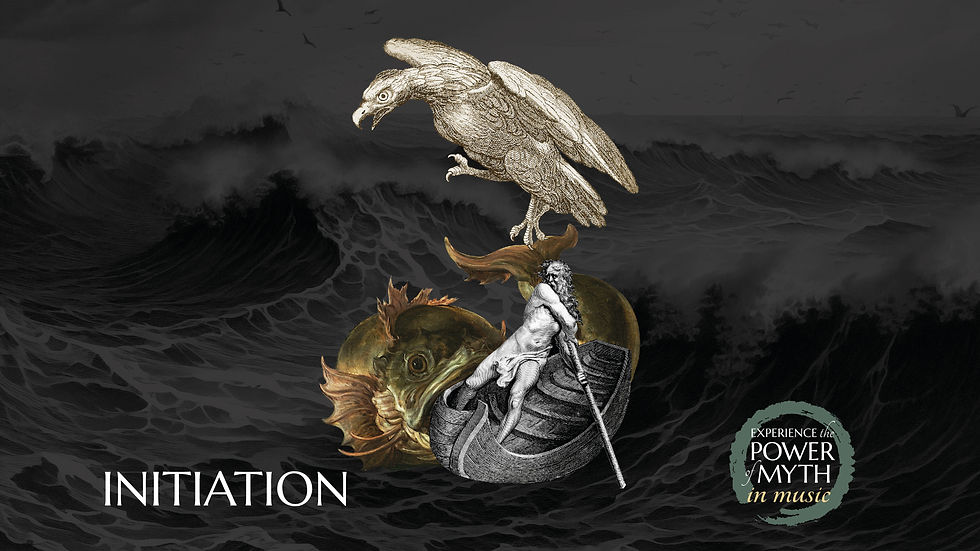
This MythBlast was inspired by the Initiation stage of the hero's journey and The Hero's Journey: Joseph Campbell on his Life and Work.
Now Streaming on Spotify—Explore the MythBlast Playlist
Latest Podcast
In this episode, Sean Brawley, performance coach, former top-ranked professional tennis player, and expert in accelerated learning, joins John Bucher for a wide-ranging conversation that begins in the world of elite sport and opens into something much deeper. Drawing on his experience competing at the highest levels and his work with Tim Gallwey and the Inner Game philosophy, Sean shares how his understanding of performance shifted from effort and control toward awareness, attention, and the way we learn. From there, the conversation moves into language, etymology, and the hidden layers of meaning within the words we use every day. Along the way, the ideas of Joseph Campbell weave through the discussion, especially the notion of following your bliss and the unexpected turns that shape a life. What emerges is a thoughtful exploration of performance, identity, and how paying closer attention - to both our experience and our language - can open up new ways of seeing and engaging with the world.
This Week's Highlights

"In Schopenhauer’s The World as Will and Idea he speaks of music as the sound that awakens the will. The rhythm of the music awakens certain life rhythms, ways of living and experiencing life. So it’s an awakener of life."
-- Joseph Campbell
The Hero’s Journey, 261