%20BB.png)
The Sand and the Bow: Music, Chaos and the Initiated Soul


There’s an experiment first performed in the eighteenth century by the physicist Ernst Chladni that reveals something about the nature of transformation that no amount of psychological attribution or theological conjecture quite manages. Chladni would scatter fine sand across a circular, flat, metal plate then draw a violin bow slowly down its edge. The sand, disturbed by the vibration, would skitter and scatter—seemingly at random—and then within moments, the sand would gather itself into breathtaking geometric patterns: mandalas, stars or lattices of extraordinary precision. The chaotic phase wasn’t the absence of order, but merely a latent order awaiting the frequency that would—finally—enable its form to appear.
This chaotic phase sits at the heart of what Joseph Campbell called the Initiation stage of the Hero’s Journey and equally sits at the heart of much sophisticated music. Both scenarios depend on the willingness to pass through apparent discord and disorder, requiring the old arrangement to fragment before anything new can crystallize and a higher form may take hold.
The scatter before the pattern
Campbell described Initiation as the process in which a radical transformation of the psyche ceases to be theoretical and becomes entirely embodied. The Hero, having crossed the threshold, is no longer who they once were. Though first there’s a waiting space—the liminal interval between realms—which is no walk in the park. The mythic “Road of Trials” and the “Meeting with the Goddess” describe these stages. There are no steady steps forward, but rather a deepening of the soul through dissolution. The self that entered these initiatory rites of passage must be scattered, and for a time, become indistinguishable from the surrounding field of chaos. Only then can a truer and more coherent pattern of self begin to emerge. Less often noted though, is that what occurs in music can also be a similar process.
This journey doesn’t produce a tranquil music of the soul. Instead, it removes it. The harmonies that once sustained the Hero—the felt sense of being held within a familiar world—fall away. There’s a threshold passage where candidates stand in what the Mystery traditions call “the inner void,” where there’s no external melody to lean upon and no inherited song to carry them forward. This is not a metaphor, but an actual discord of soul that will eventually give rise to an inner conversion.
The Eleusinian Mysteries, once celebrated annually in ancient Greece, precisely encoded this initiatory experience across two distinct phases. The Lesser Mysteries, held in early spring at Agrae on the banks of the Ilissus, were purification rites. This first phase involved preparation for a later meeting with the Threshold Guardian and was assisted by nature’s own upward surge: the warmth of the returning light and the burgeoning of new life.
The Greater Mysteries, celebrated in autumn, were of an entirely different and loftier order, requiring greater devotion from the candidates. The Initiates (mystai) processed by day along the Sacred Way from Athens to Eleusis. In the evenings, they followed the ceremonies lit up with torchlight, reenacting Demeter’s own search through the darkness for what she had lost. In this sacred and more challenging phase, the Initiates-to-be moved against the tendency and texture of the dying world.
Where spring offered the natural world as an ally with its uplifting, blossoming forces, autumn offered only the soul’s apparent stark interior. When both outer light withdraws and outer nature retreats, only then can something be kindled by the Aspirants from within themselves. The deeper Initiation emerges as a soul transmutation that can’t borrow motif and strength from the budding earth. The Aspirants must ignite an awakening from within, despite—and against—the ever-darkening autumnal season. The music of such an ignition event is not automatically conferred; it must be found in the soul’s own inner strength and resolve.
Chaos as the eye of the needle
Goethe, who encountered Chladni’s experiments and recognized in them a confirmation of his own morphological thinking, understood chaos not as disorder, but as the potent field that exists prior to manifest form. Where the mechanistic and physicalist science of his era read nature as only inert matter shaped by external forces, Goethe insisted that biological form is barely imposed from the outside ... the structure mostly arises from within the organism.
But en route from the inherent, invisible template to the manifest form, an interval of chaos arises—or rather, in respect to botany, this condition expresses itself as a series of nodal points—after which the chaos is overcome and the final form presents itself. Yet this turbulence was necessary for the arrival of this form. In other words, and now returning to our primal motif of the sand and the bow, they were never in any final sense, two different things. Rather, they were two expressions of the one unified field, though it was the friction of the bow on the plate that brought forth the manifest, beatific pattern.
Another great thinker who pondered this theme was Rudolf Steiner. Steiner, who considered Goethe his primary philosophical inheritance, extended this thinking to music. In The Inner Nature of Music and the Experience of Tone, Steiner described musical intervals as the soul’s expression in tone not as abstractions, but as lived thresholds ... each one bearing a different quality of an inner crossing.
Music in the mood of the fifth carries what Steiner understood as the initiatory quality: an interval that holds the self suspended between resolution and openness ... a suspension that reaches beyond what the tonic alone can contain. The Pythagoreans, who called the fifth the diapente and considered it to be the primary consonance after the octave, encoded the same intuition somewhat differently than Goethe and Steiner. The Pythagoreans said that this interval, more than any other, sounds like the soul recognizing something beyond its current boundary. To hear it fully is not merely a musical experience; it’s a rehearsal for dissolution.
This is the experience that the Chladni plate makes visible: the passage through formlessness is not a failure of pattern, but its precondition. So it’s essential that: the sand must be scattered before it can crystallize; the supporting harmonies of the inherited world fall silent; and the Hero pass through a silence that is neither peaceful nor blissful, but entirely indispensable. For after all, it’s the silence that rests between each note that is the very thing that allows music to come into form.
The music you make yourself
The Mystery traditions carefully protected—by never writing down or transmitting by intellectual instruction—what awaited on the far side of this silence. The content of the Eleusinian Mysteries remained secret for nearly a thousand years and the secrecy wasn’t merely an institutional demand. It was intrinsic because the knowledge that the Initiates received couldn’t be conveyed through ordinary language. It held no conventional knowledge as it resonated ... a soul resonance discovered inside the self that reconfigured the entirety of the psyche.
We can learn something critical from the sand on the Chladni plate: the initiatory ordeal doesn’t end with the Hero receiving a gift. It ends with the Hero discovering that they’ve become a different instrument of soul. The music that emerges from a completed threshold crossing is not the sound they bore before their Initiation. Instead, it’s a new and higher harmonic generated from within: not borrowed, not inherited, and certainly not performed from memory. Meister Eckhart, writing from within the Christian mystical tradition, also described the soul after genuine transmutation as bringing forth something into the world that it never contained before: not a refinement of what existed, nor a slight adjustment or improvement, but an emergence of an entirely different order.
In musical terms, this is the difference between playing a score and composing one. The pre-initiatory self interprets; the post-initiatory self originates. The harmony that becomes possible after the void is not naïve or unconflicted, but rather carries the memory of dissonance woven through it, just as tempered steel carries the imprint of fire. Consonance hard-won resonates differently than consonance simply inherited. It has depth because it required the Aspirants to strive and obtain it out of their own autonomous strength. This is the cost of Initiation, without which there can be no bearing of the fruit that is sometimes called Individuation.
The music that emerges from a completed threshold crossing is not the sound they bore before their Initiation. Instead, it’s a new and higher harmonic generated from within
Birds on the shoulder
An image from folklore appears across Celtic, Slavic, and Norse traditions of the transformed Hero or Shaman emerging from their ordeal with birds (often ravens) settling voluntarily upon their shoulders. In the Welsh Mabinogion, Branwen raises a starling in her captivity and teaches it to carry word of her suffering across the sea: a soul-messenger moving between severed worlds. Birds in these traditions consistently signal a register of reality imperceptible to ordinary consciousness. Such birds speak to us in a register that’s inaudible to the untransformed ear. What this bird and its image encode is not merely favor or blessing; it’s the arrival of a new and higher harmonic field within the soul. The individuated self now resonates at a frequency that only the purist of the natural world recognizes and moves toward.
Čiurlionis (whose music I discussed in my last MythBlast) celebrates this longing for reunion with the natural world through sound. His symphonic poems do not merely describe nature ... they attempt to recover a relationship with it, and in so doing, restore the frequency at which the human soul and the world were once in vital accord. What Čiurlionis was reaching for—and what the Initiates touched in the torchlit darkness at Eleusis—is the same truth that the Chladni plate demonstrates in a laboratory: chaos is not the enemy of harmony, but its origin.
So to conclude, the sand must be scattered. The bow must be drawn. And then not as reward, but as consequence, something within the Hero begins to change through enduring the void. The ordeal tunes the soul towards notes that couldn’t have existed before the crossing: a new and higher harmonic shaped by silence, tension, and dissolution. This is what Initiation always was ... is ... and will continue to be. Not a rite performed upon the self, but the gradual reforming of the self into something capable of creating its own unique music—and then in time—becoming the authentic composer of one’s own life.
MythBlast authored by:

Kristina Dryža is an ex-futurist, author, TEDx speaker, archetypal consultant, one of the Joseph Campbell Foundation’s Editorial Advisory Group, and a steward for The Fifth Direction. Based between Australia and Lithuania her work focuses less on the future and more on the unknown. Presence. Not prediction. What’s sacred? Not only what’s next. Kristina is passionate about helping people to perceive mythically and sense archetypally to better understand our shared humanity, yet honor the diverse ways we all live and make meaning. To learn more about Kristina, you can view her TEDx talk: Archetypes and Mythology. Why They Matter Even More So Today https://www.youtube.com/watch?v=2o4PYNroZBY&t=525s
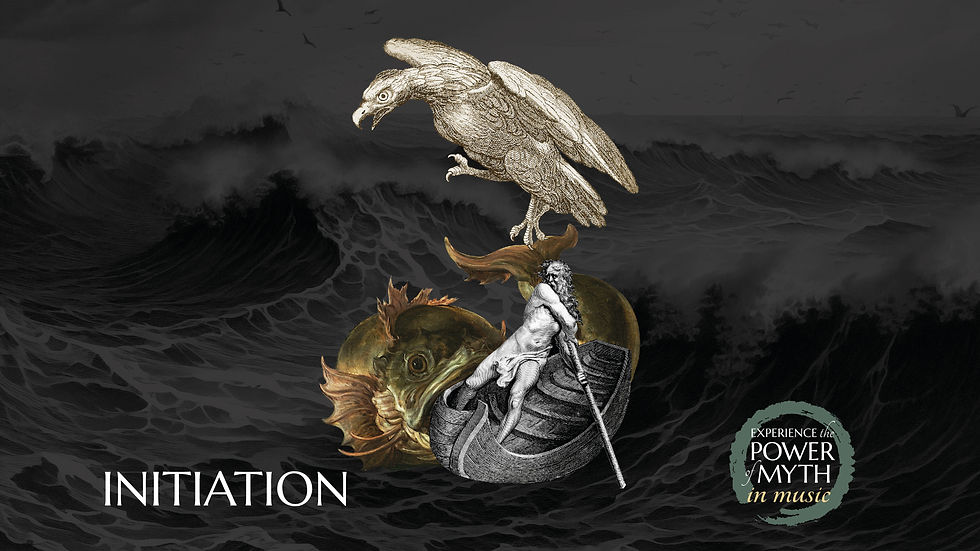
This MythBlast was inspired by the Initiation stage of the hero's journey and The Hero's Journey: Joseph Campbell on his Life and Work.
Now Streaming on Spotify—Explore the MythBlast Playlist
Latest Podcast
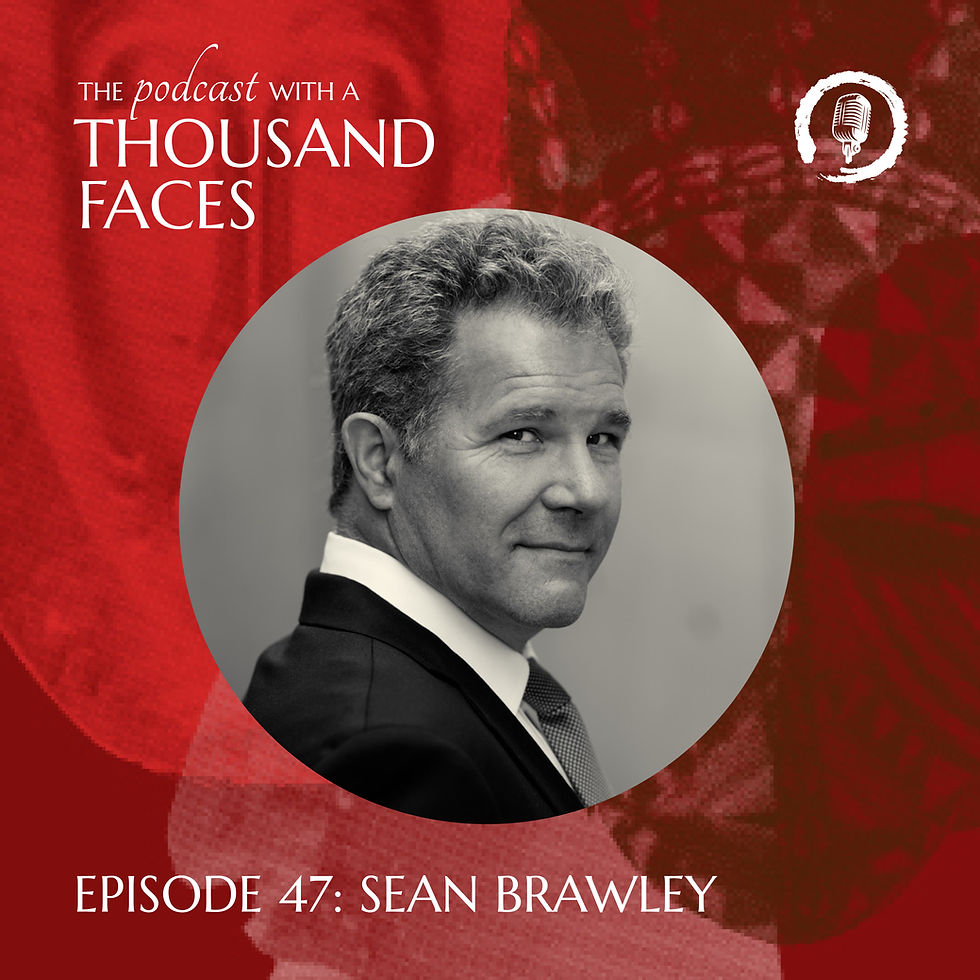
In this episode, Sean Brawley, performance coach, former top-ranked professional tennis player, and expert in accelerated learning, joins John Bucher for a wide-ranging conversation that begins in the world of elite sport and opens into something much deeper. Drawing on his experience competing at the highest levels and his work with Tim Gallwey and the Inner Game philosophy, Sean shares how his understanding of performance shifted from effort and control toward awareness, attention, and the way we learn. From there, the conversation moves into language, etymology, and the hidden layers of meaning within the words we use every day. Along the way, the ideas of Joseph Campbell weave through the discussion, especially the notion of following your bliss and the unexpected turns that shape a life. What emerges is a thoughtful exploration of performance, identity, and how paying closer attention - to both our experience and our language - can open up new ways of seeing and engaging with the world.
This Week's Highlights

Just as anyone who listens to the muse will hear, you can write out of your own intention or out of inspiration. There is such a thing. It comes up and talks.
And those who have heard deeply the rhythms and hymns of the gods, the words of the gods, can recite those hymns in such a way that the gods will be attracted.
-- Joseph Campbell
The Hero’s Journey, 147