%20BB.png)
“While the Music Plays the Band”

Death, Deadheads, and the Grateful Dead
This is modern mythology. And you guys are the heroes of this new culture, this new world.
-Joseph Campbell, reported by Steve Parish in Home Before Daylight: My Life on the Road with the Grateful Dead
Grateful Dead cofounder, vocalist, and rhythm guitarist Bob Weir “checked-out” (his preferred phrase) this past January at age 78. Like so many others, I felt grief at his passing, but also gratitude for the decades of joy and insight I experienced through the Dead’s music, which forms the soundtrack of my life.
So many memories have surfaced of Dead shows long past—but one concert in particular stands out: the first of a five-day run at Kaiser Auditorium, in Oakland, CA, on February 8, 1986. Couldn’t help but notice a handful of theater seats had been added stage left. At the time, neither I nor my companions had any idea who the beaming elderly couple seated there might be, but the unusual stage arrangement, along with a brief discussion on the drive home contemplating which band member's parents might still be alive, etched their presence into my memory.
Two years later, when the Power of Myth interviews aired, I had one heck of an "aha!" moment:
Mickey Hart and Bob Weir of the Grateful Dead come along and tell me I’ve helped them. Well, I never—the rock music never appealed to me at all . . . Then they invited Jean and me to an event in Oakland that just became a dance revelation. I got something there that made me note this is magic. And it's magic for the future. (Joseph Campbell, The Hero’s Journey, 257)
Joseph Campbell had met the members of the Grateful Dead not long before, over dinner at Weir’s home. Weir, percussionist Mickey Hart, and band patriarch Jerry Garcia—all familiar with his work—were as charmed by the mythologist as he was by them. They invited the 82-year-old scholar to that show at Kaiser, where he was struck by the resonance he perceived with ancient Dionysian rituals of transformation. Campbell acknowledged the musicians as “consummate artists,” later describing the experience as a wonderful, fervent loss of self: “I was carried away in a rapture. And so, I am a Deadhead now” (ibid., 257).
The Grateful Dead prioritized live performance over album sales; even then, over two decades into their career, the band had yet to place a single tune in the top ten. The media often portrayed the group (and their following, a loose, colorful caravan of tie-dyed “Deadheads”) as curiosities at best—hippie has-beens, living in the past.
What did Joseph Campbell catch that the critics missed?
The unstruck note
Music is still something that works. The gods are still speaking through the music. You know it isn’t us. It’s something else.
-Jerry Garcia, in conversation with Joseph Campbell and Mickey Hart,
The Palace of Fine Arts in San Francisco, November 1, 1986
The Grateful Dead were a collection of musicians in search of, and sometimes finding, what Garcia called “the unstruck note.” They shared that quest with their audience as it unfolded live, onstage, the same but different every single night. No two set lists were ever repeated, nor any song played the same way twice—but Dead shows did tend to follow a common trajectory, a pattern that evoked a powerful transformational experience for many.
Grateful Dead songs tell stories of heroes and anti-heroes that mirror the monomyth Campbell described. For Deadheads, though, attending a show was itself a hero’s journey—an experience memorialized in Bob Weir and John Barlow’s song, “The Music Never Stopped.” If you have not been to a Grateful Dead performance, the linked video is an opportunity to catch some small sense of the live experience. The notes of the individual instruments sound so sweet and delicate at the outset, each a unique, independent voice, weaving seamlessly together to form a single harmonious tapestry that places the audience in the role of the collective hero.
It begins, like all hero’s journeys, in the doldrums of the Ordinary World, where a Call to Adventure is heard:
There’s mosquitoes on the river
fish are rising up like birds
It's been hot for seven weeks now
Too hot to even speak now
Did you hear what I just heard
Say it might have been a fiddle
or it could have been the wind
But there seems to be a beat, now,
I can feel it in my feet, now
Listen, here it comes again!
What follows is a succinct description of both the Dead, and the traveling circus of Deadheads that made the parking lot scene as much a part of the show as the performance itself:
There’s a band out on the highway,
they’re high-steppin’ into town
It’s a rainbow full of sound
It’s fireworks, calliopes and clowns
Everybody’s dancin’
C’mon children, c’mon children
Come on clap your hands
Time dissolves as everyone loses themselves in the music, and each other:
People joining hand in hand
while the music plays the band
Lord, they’re setting us on fire
Campbell has observed that thunderbolts in myth and literature often telegraph a transcendent illumination:
Crazy rooster crowin’ midnight
balls of lightning roll along
Old men sing about their dreams
Women laugh and children scream
and the band keeps playing on
After this passage in the song comes a new dawn, and
No one’s noticed, but the band’s all packed and gone
Were they ever here at all?
The journey ends with a Return to the Ordinary World that is ordinary no more:
Well, the cool breeze came on Tuesday
And the corn’s a bumper crop
The fields are full of dancin’,
Full of singing and romancin’
The music never stopped
But what is the illumination hinted at in the song?
Doorway to the mythological dimension
We are all, as it were, creating our death every day of our lives.
Campbell at “Ritual & Rapture”
There’s no dearth of ruminations on death at a Dead show. Songs like “Black Muddy River,” “Death Don’t Have No Mercy,” and “Box of Rain” reflect the death-and-rebirth motif threading its way through a performance.
Joseph Campbell expands on the mythological significance:
There’s that wonderful picture of Death playing the violin to the artist, by a Swiss painter named Böcklin. The artist is there with the palette and brush, and Death is playing the violin. That means that the eyes should be open to something of more cosmic import than simply the vicissitudes and excitements of your own petty life. Hearing the song that is beyond that of your own individual life cycle is the thing that opens you to wisdom. You can hear it in your life, interpreting it, reading it, not in terms of the calamities or boons of your individual existence, but as a message of what life is.
Oh, it’s a beautiful accent! That’s mythological. That’s the mythological dimension. (Joseph Campbell, Myth and Meaning, 12, emphasis mine)
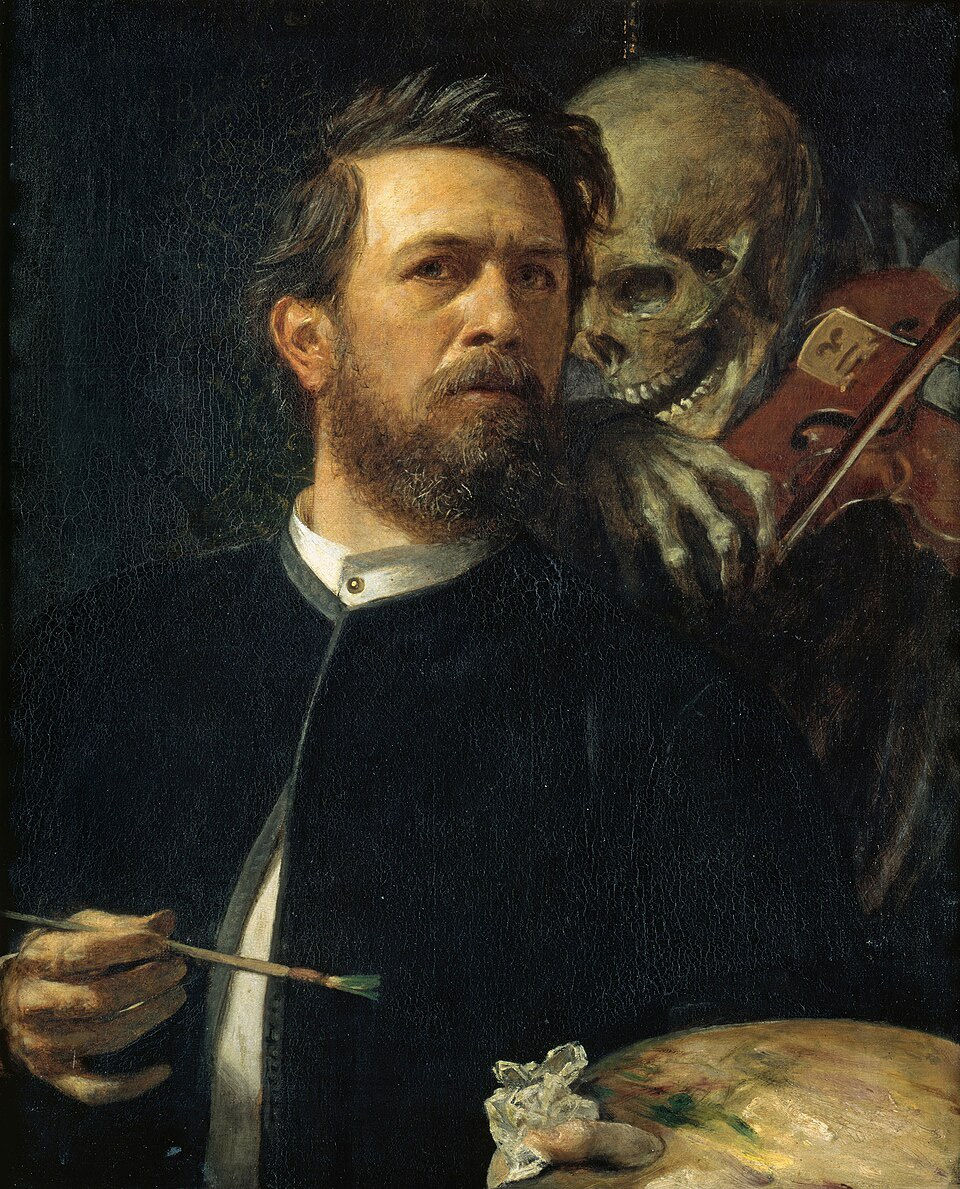
Arnold Böcklin, Self-portrait with Death playing the fiddle (1872). Oil on
canvas, 75 × 61 cm (30 × 24 in). Alte Nationalgalerie, Berlin
As if the band’s name weren’t already a clue, a congruent image, though playing directly to us, adorns the cover of the Grateful Dead’s 1975 Blues for Allah.

Grateful Dead, Blues for Allah LP, Front. Grateful Dead Records.
Album Cover Painting: Philip Garris
These “death songs” seem sweet yet mournful dirges that emphasize the inevitable (e.g., Black Peter’s “See hear how everything lead up to this day, and it’s just like any other day that’s ever been”), yet also reflect what Campbell calls the bodhisattva formula: “Joyful participation in the sorrows of life.” So, in “He’s Gone,” while the song laments “Nothing’s gonna bring him back,” there’s ultimately “Nothing left to do but smile, smile, smile.”
Over the course of each show, the audience would be taken on a journey that reaches a pivot point midway through the second set, where musical forms fade and only the drummers remain on stage to paint a shamanistic soundscape. “Space” follows, a freeform musical conversation between guitars and keyboards, with recognizable songs eventually emerging from the abyss. The second half of the set signals a sense of rebirth and renewal, often culminating in a rousing dance anthem (such as “Sugar Magnolia” or “Not Fade Away”).
Hearing the song that is beyond that of your own individual life cycle is the thing that opens you to wisdom.
Dead ahead
Jerry Garcia died in 1995, and the name died with him. The other band members continued playing in a variety of configurations, and even briefly resurrected the Grateful Dead for a handful of stadium shows in 2015 celebrating their 50th anniversary. With bass player Phil Lesh’s passing in 2024 and Bob Weir’s death this winter, only drummers Bill Kreutzmann and Mickey Hart remain, still pounding out their rhythms.
Joseph Campbell proved prescient. No longer hippie has-beens, the band holds the Guinness World Record for most albums ever (66) in the Top 40. Recognized at the Kennedy Center Honors in 2024 for their dedication to the craft, tireless philanthropic efforts, and extensive cultural contributions, the Grateful Dead continue to inspire generations of artists and fans alike.
“The band’s all packed and gone”––but, as the song promises, the music never stops.
For more on the Grateful Dead, read “The Grateful Dead, Adult Entertainment, and Native Tongues,” a brief essay by my friend and colleague, JCF Executive Director John Bucher.
MythBlast authored by:

Stephen Gerringer has been a Working Associate and Research Coordinator at the Joseph Campbell Foundation (JCF) since 2004. His post-college career trajectory interrupted when a major health crisis prompted a deep inward turn, Stephen “dropped out” and spent most of the next decade on the road, thumbing his away across the country on his own hero quest. Stephen did eventually “drop back in,” accepting a position teaching English and Literature in junior high school. Stephen is the author of Myth and Modern Living: A Practical Campbell Compendium, as well as editor of Myth and Meaning: Conversations on Mythology and Life, a volume compiled from little-known print and audio interviews with Joseph Campbell.

This MythBlast was inspired by the Separation stage of the hero's journey.
Now Streaming on Spotify—Explore the MythBlast Playlist
Latest Podcast

Pathways with Joseph Campbell is an official podcast of the Joseph Campbell Foundation and the MythMaker Podcast Network, hosted by Brad Olson, PhD. Each episode uncovers rare recordings of Joseph Campbell and explores the deeper currents beneath his words. The hero’s journey never really ends. It just takes a breath. We are taking a brief pause. New episodes return in June. Until then, explore the archive - five seasons of conversations that illuminate myth, meaning, and the human adventure. Subscribe and listen wherever you get your podcasts. Share with your friends and leave us a review!
This Week's Highlights

"Hearing the song that is beyond that of your own individual life cycle is the thing that opens you to wisdom. You can hear it in your life, interpreting it, reading it, not in terms of the calamities or boons of your individual existence, but as a message of what life is."
-- Joseph Campbell